Got it. What's Next?

Category: Technology (Page 1 of 4)

The Two Types of Marketers: One Will Thrive, One Won’t

(Part 1) (Part 2) (Part 3)

I can tell within about five minutes of talking to someone which type of marketer they are. Not because I’m particularly insightful. Because the pattern has played out the same way across every technology shift I’ve worked through.

There are two types. One adapts. One doesn’t.

Type A: The Tool Master

Type A built their career on execution. They became the person who knew how to do the thing nobody else could figure out.

Continue reading

The Interview Question That Reveals Everything: ‘Fix This AI Output’

(Part 1) (Part 2) (Part 4)

Many marketing interviews are terrible at predicting job performance.

You ask about their experience. They tell you about campaigns they worked on. You ask behavioral questions. They’ve rehearsed responses since college.

None of it tells you what you actually need to know. Can this person tell good from bad? Do they have judgment?

I’ve started using a different approach. I give them AI-generated work and ask them to fix it.

How It Works

Before the interview, I use ChatGPT or Claude to create something relevant to the role. An email campaign. A blog post. Product copy. Whatever matches what they’d actually be doing.

I don’t use a perfect prompt. I use a mediocre one. The kind a busy manager might actually write at 4pm on a Friday.

The AI output is usually pretty good. Sometimes it’s 80% there. Sometimes it’s impressively wrong in subtle ways. That’s the point.

In the interview, I hand it to them and say, “I had AI generate this. Take 10 minutes and tell me what you’d change and why.”

Then I shut up and watch.

What You Learn

The responses split into three categories pretty quickly.

Type 1 makes surface-level edits. They fix a typo. Maybe adjust some formatting. They can spot obvious errors but can’t evaluate strategic quality.

Type 2 tears it apart and rebuilds it. They explain what’s missing, what’s off-brand, where the logic breaks down. They can articulate why the tone is wrong for the audience or why the call-to-action won’t work. These are the people you want.

Type 3 is rarer but interesting. They say, “Actually, this is pretty good for [specific use case], but it completely misses the mark for [the actual objective].” They’ve identified a fundamental strategic problem before getting into tactical fixes.

Type 2 and Type 3 are showing you judgment. Type 1 is showing you someone who can follow instructions but can’t think critically.

Why This Works

When I worked with companies navigating social media in the early 2010s, the best interview question wasn’t “what’s your engagement rate?” It was showing them three competitor posts and asking which one they’d model and why.

Same principle here. You’re testing whether they can recognize quality, articulate problems, and think strategically about solutions.

Research from the lending industry proves the point. When humans and AI evaluated information together, default rates dropped to 3.1% MarTech compared to either working alone. But that only works if the human knows how to evaluate what the AI is producing.

What Bad Answers Sound Like

“I’d make it more creative.” (Translation: I have opinions but can’t articulate reasoning.)

“I’d run it through Grammarly first.” (Translation: I’m focused on mechanics, not strategy.)

“It’s fine, I’d probably just use it.” (Translation: I can’t evaluate quality or I’m afraid to critique anything.)

What Good Answers Sound Like

“The headline is clickbait-y but the article doesn’t deliver on the promise. I’d either change the headline to match the content or rewrite the intro to fulfill what the headline sets up.”

“This reads like it was written for a general audience, but our buyers are technical. I’d cut the explainer paragraphs and get to the specifications faster.”

“The tone is way too formal for our brand. We sound like a law firm, not a startup. I’d rewrite this entire section to sound more conversational.”

See the difference? They’re not just pointing out problems. They’re explaining the why behind the problem and proposing a fix that connects back to strategy or audience.

This also reveals something important: Are they comfortable saying “this isn’t good enough”? Because in six months, their job will involve telling AI to try again. A lot. If they can’t critique a piece of copy in an interview, they probably won’t manage AI output effectively on the job.

Try It Yourself

Next time you’re hiring, spend 5 minutes generating something with AI. Hand it to your candidate. Give them 10 minutes.

You’ll learn more than you would from an hour of behavioral questions.
Is Your Marketing Job Description Hiring for 2019

(Part 1) (Part 3) (Part 4)

I review a lot of marketing job postings. Most of them look like they were written six years ago.

“Proficient in Adobe Creative Suite.” “Experience with video editing software.” “Knowledge of HTML/CSS a plus.” “Familiarity with marketing automation platforms.”

These aren’t bad skills. They’re just increasingly irrelevant.

It’s like posting a job in 2010 that required “expert knowledge of the Dewey Decimal System” when Google already existed. Sure, librarians still needed to understand information architecture. But the actual skill that mattered had shifted completely.

Continue reading

I’ve Seen This Movie Before: Why the AI Shift in Marketing Isn’t Really About AI

(Part 2) (Part 3) (Part 4)

I’ve been doing this long enough to spot the pattern.

In the late 1990s, I worked at Progressive Networks, which changed its name to RealNetworks. We were pioneers and created ways for companies to navigate the shift to video on the internet. Not everyone survived. The ones who did weren’t necessarily the best videographers. They were people who understood what video meant for storytelling and user behavior and how the internet was going ot expand that audience.

Then came mobile in the mid-2000s. iPhone. Android. Suddenly everyone needed an app. I helped clients figure out what that meant for their business. Again, success didn’t go to the best coders. It went to people who understood what a pocket-sized screen changed about how people consumed content.

Social media followed in the early 2010s. Facebook ads. Instagram. Twitter. I saw the same pattern repeat itself. The tool-masters struggled while strategic thinkers adapted to what it meant to let customers suddenly have access to your executives, and the way to broadcast to millions without your PR team being involved.

Now we’re in shift number four: AI.

And honestly? It’s the same movie playing again. Just different special effects.

Continue reading

Email.com – A Strange, Lonely URL

I’d love to know the story why a high value url like Email.com sits unused. Surely some company has the capital to buy the url and redirect it to their own email platform. Gmail? Heck, it seems like just the thing Microsoft would do to boost traffic to Bing. Anyone know the story?

Is Twitter Still a Platform for Real People? Or Just a Megaphone for Certain Echoes?

TL;DR Version

Twitter used to be a platform for discovery, curiosity, and real conversations. Over time, it shifted, to a space for customer complaints, then into a political battleground, and eventually into something stranger. Today, much of what passes for “debate” is driven by bots, automated replies, and talking points that feel like they were built in a conspiracy theory factory.

Research backs this up. Bots have been responsible for a disproportionate amount of political content for years, up to 30% or more, depending on the topic. The result is a platform where real engagement is harder to find, and actual people seem increasingly absent.

Continue reading

Imagery for Focus

Research in psychology and psychiatry suggests that certain types of images or visual stimuli can help individuals improve focus and reduce distractions. These images often leverage principles of attention regulation, mindfulness, and environmental design. Here are a few scientifically-backed approaches:

1. Nature Scenes

  • Why it works: Studies show that exposure to nature or even viewing images of natural environments can restore attention and reduce mental fatigue. This is based on the concept of Attention Restoration Theory (ART), which suggests that natural environments engage our attention in a gentle, involuntary way, allowing the directed attention system to rest.
  • Example Images: Forests, flowing water, mountains, and greenery.
  • Best Use: Displaying posters, screensavers, or paintings with calming natural scenes.

2. Abstract Art with Low Complexity

  • Why it works: Complex or cluttered images can overstimulate individuals with ADHD, while simple, abstract designs or patterns can create a calming effect and reduce distractions.
  • Example Images: Geometric patterns, smooth color gradients, or minimalist art with soft tones.
  • Best Use: Use as background art in workspaces or as phone wallpapers.

3. Mandala Patterns

  • Why it works: Mandalas and other symmetrical designs can promote mindfulness and focus through their repetitive and orderly structure. Some ADHD therapies include coloring mandalas to improve focus and reduce hyperactivity.
  • Best Use: Use as interactive exercises (e.g., coloring apps) or as visual elements for meditation breaks.

4. Images with Blue and Green Hues

  • Why it works: Blue and green are associated with calmness and focus. Research has shown that these colors can help regulate mood and improve attention span.
  • Example Images: Ocean waves, clear skies, green fields.
  • Best Use: Backgrounds for work environments or calming breaks.

5. Goal-Oriented Visuals

  • Why it works: Visuals that represent goals, steps of a task, or progress can help individuals with ADHD stay task-oriented. Seeing a visual roadmap of their objectives can reduce the cognitive load and prevent distractions.
  • Example Images: Infographics, step-by-step diagrams, or progress trackers.
  • Best Use: Incorporate into task planning or to-do lists.

6. Soft Animated Visuals

  • Why it works: Slow, non-distracting animations (like a gentle ocean wave or a flame flickering) can serve as a grounding point for focus. These animations are particularly useful for reducing anxiety and helping individuals stay engaged without overstimulation.
  • Best Use: Display on digital devices or monitors as a background focus tool.

7. Visual Reminders of Break Spaces

  • Why it works: Seeing a calming visual associated with a planned break (e.g., a peaceful garden or quiet reading corner) can create a mental cue for focused work until the break arrives.
  • Example Images: Personalized images of a favorite relaxation spot or a digital timer with an image of the break area.
  • Best Use: Use as desktop backgrounds or on task management tools.

Why Businesses Should Be on TikTok Before the Year Ends

I know you’re going to hate hearing this. I hate writing it. But if your brand still isn’t on TikTok as 2023 wraps up, you may be behind. This isn’t trend-chasing. We have to suck it up and go where attention lives. TikTok is shaping buying decisions across nearly every demographic, not just Gen Z.

1. People Are Spending Serious Time Here

TikTok now has over 1 billion monthly active users, and the average person spends about 95 minutes per day on the app. That’s more screen time than Netflix for some people (Saintnicks). And it’s not background noise. People are watching closely, not just scrolling past.

2. The Algorithm Works in Your Favor

You don’t need a huge follower count. TikTok’s algorithm recommends content based on what people like to watch, not who they follow. That gives smaller brands a legit shot to go big—even from zero. (Wikipedia – TikTok)

3. Low Budget, High Impact

You don’t need fancy gear or a studio. TikTok rewards authenticity. A founder talking to their phone camera can outperform a polished brand ad—if the message hits home (Third Wunder).

4. It’s Already Working for Small Businesses

This isn’t theory. One small brand boosted revenue by 1,650% after going viral on TikTok (Business Insider). TikTok itself reported $24.2 billion in economic activity from small businesses using the platform in 2023 (TikTok Newsroom).

5. TikTok Shop Removes Friction

Launched in September, TikTok Shop lets you sell right inside the app. No redirecting people to your website. No friction. You see it, you click it, you buy it (Wikipedia – TikTok Shop).

6. People Trust What They See

A TikTok study found that 92% of users who took action after watching a video said they did it because the content made them feel something. And 72% said they trust TikTok creators more than traditional ads (TikTok “What’s Next” report).

The Takeaway

TikTok isn’t just silly videos anymore. Used effectively, it can be a source of leads.

What I Learned – The Bird Scooter

For weeks now, I’ve read articles blaming The Bird Scooter for everything from congested sidewalks to world hunger.

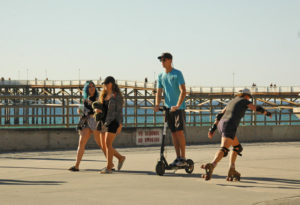
But last weekend I was down in San Diego where hundreds of thse things can be found along the Boardwalk in Pacific and Mission Beach.

Source: Thomas Melville, SDNews.com

The concept behind the scooter is simple. Like Car2Go, you download an app and look for a nearby scooter. When you see a scooter close to you, you walk to it, then “Unlock it” using a QR code. Then you ride it where you need and “Lock it” so someone else can use it. Locked scooters are almost impossible to roll anywhere and make a beeping noise that alerts that someone is trying to steal it.

The boardwalk along Pacific Beach and Mission Beach is pretty long. It could take you 40 minutes or more to walk from a bar to your hotel. But with The Bird, you just hop on, and cruise at a nice safe 8-12 MPH, cutting your time by about 66-75%. It costs $1.00 to start it and $0.15 a minute. So it’s roughly the cost of a short Uber ride, but way more fun.

After using it for a weekend, I think the haters in San Francisco are ridiculous. I was able to navigate the scooter through pedestrians, bikers, unicyclists, skateboarders, roller bladers, and other scooter riders. My only near accident was caused by a 5 year old on his non-motorized scooter who decided to come at me head on while in my lane. But it was easy for me to stop the scooter and dodge the kid at the last minute.

Source: Thomas Melville, SDNews.com

Also, you can ride remarkably slow and still keep your balance. In fact, you can literally slow to walking speed if you see someone you know and want to travel at their pace, or see a group of pedestrians going 5-wide and blocking the entire path.

The downside: Even on a small hill, I was pretty uncomfortable, and my repressed teenage memory of crashing into a tree while trying to ride a skateboard down a hill in Bellevue suddenly re-surfaced. So, I don’t know if I’d come down from 6th to 2nd downtown. But for getting around Wallingford, Greenlake or Capitol Hill, these things would be great.

Bikers will yell and scream that you should just ride a bike instead. But really, if you are going out to dinner, do you want to get sweaty riding a bike? No, a scooter is effortless. And a bike is actually much larger than The Bird. You take up way more room on a road or bike lane.

So, what I learned is that the scooter is an effective form of short-form travel in flat areas. I’d like to see it become more prevalent up here. Ignore what the haters in San Francisco say. If they are so worried about being a pedestrian and getting hit by a scooter, then they should jump on a scooter.

What We Are Going to Do in 5 Years With All Those Non-Driverless Cars?

I’m not really a car guy. I like when other people have really nice cars, and I could certainly afford to have a nice car, but for some reason I’m wired to be perfectly happy driving the same Acura for the last 16 years. But 16 years is a long time and the reality is that my car will die someday. So I have started looking around for my next automobile.

However, my research hit a snag almost the moment I started. You see, everything I read is that driverless cars are somewhere between 5 and 10 years away. Which begs the question? Why on earth would I buy a regular car today, if no one will want to buy it when the driverless versions start coming out?

And the bigger meta-question is, what the heck will happen to the millions and millions of regular automobiles out there? Here are some options.

  1. Some really smart people are going to figure out how to transform regular cars into driverless ones. Or, I suspect the GM, Ford, Acura, Toyota, etc… will all figure out a way to do it.
  2.  In 3 to 5 years, leasing becomes such an attractive option that there’s just no reason to buy a new car. You’ll have one last regular car for 3-5 years and in your next lease you’ll get a driverless one.
  3. There will be an amazing glut of really nice 5 year old cars on the market.  In 2022, the supply of 2019 BMW’s will so outpace the demand that people who don’t choose a driverless option will be able to get a car that’s nicer than anything they ever thought they could afford.

But the crux of the issue is this. What do I do? Do I just wait until my car dies? Or do I hope it lasts 5 more years and be the first kid on the block with a driverless car? Thoughts?

« Older posts

© 2026 Andy Boyer

Theme by Anders NorenUp ↑