- Craig Biggio: 2850 G, 3060 H, 1844 R, 668 2B, 291 HR, 414 SB, .281 BA, .791 OPS, Played C, 2B and OF
- Derek Jeter: 2602 G, 3316 H, 1876 R, 525 2B, 256 HR, 348 SB, .312 BA, .828 OPS, Played SS
Page 19 of 86
I’ve been doing more thinking recently about the role a resume (or LinkedIn Profile) plays in your job search. What is the perfect blend of connections, qualifications, overall talent and past experience?
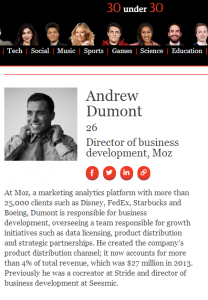
Coincidentally, today Forbes released its annual 30 under 30 lists. Highlighted in the Marketing list is Seattle’s own Andrew Dumont. This inclusion did not surprise me in the least. It’s a great honor and well deserved.
It reminded me of the time I first met Andrew. I was a Principal at another social media agency at the time, and no less than 3 members of the team said, “You have to meet this guy. Super bright.” I was curious why his resume never made it to my desk despite everyone having such great things to say about him, so I inquired.
Our Office Manager was the gate keeper for incoming resumes. This person had certain skills and an ability to color inside the lines, but little ability to do any creative or lateral thinking, and sometimes even struggled if forced to make a decision on which crayon to choose. It turns out a hard and fast mandate had been implemented, “No college degree, no interview.” So despite Andrew’s entrepreneurial successes and social media prowess, our gate keeper would not allow us to talk to him.
But too many people told me I had to meet Andrew, so I chose a day when the gate keeper was on a holiday and invited the 20 year old in. It became clear within 30 seconds that we couldn’t hire him – we’d just never be able to afford him. I knew what we paid our junior team members and he was worth 2-3x that. I knew we’d never be able to make the numbers work, but I was really glad my colleagues had made the introduction.
Years later, I’m an old guy who pays attention to Andrew’s successes and tries to learn from him. It doesn’t matter if I have more experience – he’s the one wearing X-ray glasses that cut through the clutter and can see the future. But not only that, he makes time to support the Seattle start-up community. I’ve been able to interview him for a couple of panels, and he’s supported my class at the UW whenever I’ve asked.
So tying this back to the original topic: Talents vs Resume. A good HR person is recruiting talent that can add value to the future of company. And the easiest scorecard or scouting report to read is a resume. But a resume is usually just a recap of the past. It is not necessarily a predictor of future events. The HR person wants to see what your talents are, and if those talents translate into something their team needs. So you had a job at big company X. That’s great. It shows you can get a job. But what talent did you bring to the team? How much did the team win? What else did you learn while you were there?
Some people have outstanding talents that have never been showcased in a professional environment for whatever reason – bad managers, shrinking industry, crisis management, etc… Some great strategists spend their early careers putting out fires instead of planning the company’s future. But you have a ton of non-resume opportunities to showcase the talents you can bring to a company. Writing, volunteering, starting side projects, mentoring, being mentored, etc…
In a nutshell… When I met Andrew he was clearly talented, and we had an Office Manager that discriminated against him for not having the right resume. I’m sure we weren’t the only ones. But then there were other companies that evaluated his potential, not his past. And now he’s in Forbes as a 30 under 30 winner.
Moral of the story: Managers – Look for the talent, not the resume. Job seekers – Showcase your talents and don’t let a resume hold you back. This equation adds up to the right HR people hiring the right young talent. And companies full of talent and potential are the ones you end up seeing on CNBC.
I had the chance to do a little work and visit Sweden towards the end of December. I had every intention of writing and publishing a ton of material. I did accomplish the writing part – volumes and volumes of content. But not all of it is ready to be published. So instead of waiting around and trying to get it all together, here’s a short recap that’s a little dated now, but talks about my first week or so.
——
Ok, its Sunday afternoon here in Sweden, so factoring in the 15 hour trip, 9 hour time difference, and the fact that it gets dark at 3:30pm, I think I’ve been here somewhere between 3 and 12 days. Hard to know exactly.
Some photos: http://flic.kr/s/aHsjPZL7VZ
No these aren’t from 2013, but I think they reflect my mindset as I head out of the year and into a new one. It’s a good time to reflect on them.
- “When a person really desires something, all the universe conspires to help that person to realize his dream.” – Paulo Coelho
- “Everything good I have came from honesty, good intentions, and low expectations.” – Frank Chimero
- “Never be afraid to try something new. Remember, amateurs built the ark. Professionals built the Titanic.”
- “Either write something worth reading or do something worth writing.” – Ben Franklin
- “If you don’t like change, you’re going to like irrelevancy even less.” – General Eric Shinseki
- “Truth is stranger than fiction, but it is because Fiction is obliged to stick to possibilities; Truth isn’t.” – Mark Twain
- “Age ain’t nuthin’ but mind over matter. If you don’t mind, it don’t matter.” – Satchel Paige
- “The world is made for people who aren’t cursed with self awareness.” – Annie Savoy
- “All you need is ignorance and confidence and the success is sure.”
- “I’ve been asked this question a lot, How do you want to be remembered…to be remembered at all is pretty special.” – Cal Ripken Jr
- “It’s really hard to design products by focus groups. A lot of times, people don’t know what they want until you show it to them.” – Steve Jobs
I was talking to one of my young entrepreneurial friends today. It had been a while since we caught up so the conversation predictably started around, “How’s everything going?”
The funny thing about entrepreneurs is that nothing is ever going poorly. Setbacks are learning experiences. Unexpected hurdles are blockers for future competition. Lack of clarity in a mission is pause for contemplation.
People with jobs have a bad day. Entrepreneurs have a new challenge.
We ruminated on this awhile and came up with the analogy that entrepreneurship is like football. You build the best team you can, develop a system you think will work, scout out the competition, and take your game to the field. During the game you run your plays, knowing 11 people are trying to stop you. When you get the ball, you run into the defense, driving as hard and as long as you can go on each play.
Eventually you have to make strategic decisions. When you see something working, you ride it as long as you can. If the situation is hopeless, you punt and regroup. Somedays you have a great game plan and the right team. Somedays you have a great team and the wrong plan. And somedays, you just get blown out of the water by people more talented than you.
Anyway, I thought it was a fun conversation. Keep those legs driving forward….
It’s coffee break time. So I head over to Deadspin.com to do a quick scroll to see if there’s anything im-sport-ant for me to follow up on. (Yes I created that term to describe important sports news, and I will allow you to use it…)
The latest story on the A-Rod mess attracts my attention. I read the story. I see both sides to the issue. I want more info.
So here’s the main plot point in my story here – I am looking for objective, fair and unbiased facts that I can read through. I want to get news, not filtered bullet points provided by either side’s PR teams. I unconsciously scroll through my mental list of places to type in my browser next. Here’s how that thought process went:
- MLB.com – No, that’s a marketing site, not a sports news site.
- Espn.com – No, they will basically have someone from MLB.com writing the story, with the CFO and head of the MLB / ESPN relationship approving it. It will be completely one-sided.
- FoxSports.com – No, they aren’t going to bite the hand that feeds them either.
- SeattleTimes.com – No, the baseball beat writers are probably on furlough until February.
- SportsPressNW.com – Yes, I’ll check them out, but will expect the article later in the week since it’s not pressing news right now.
- 710Sports.com – No, the home of the Mariners is not going to write anything negative about MLB.
- Any of the news sites – No, they are probably just going to have 3-4 paragraphs pulled from MLB.com.
- USSMariner.com – YES. they may not have the story, but I bet the KNOW where a good article is.
And I was rewarded. A USSMariner.com article had a link to this awesome piece by Wendy Thurn at Fangraphs.com.
But now think about this. I have been trained that whenever there is an “insportant” story, I can’t go to any major media outlet to get fair coverage. The news, sports and entertainment divisions of companies are so intertwined, my unconscious reaction is to ignore anyone who has any official relationship with Major League Baseball. Not to read the story with a grain of salt on my tongue. Not to read the story and then look for countering arguments. But to sidestep all broadcasters associated with MLB all together.
Am I too cyncial? Maybe. Or maybe I’ve just been conditioned to know what to expect from them.
This is pretty much purely my speculation…
Fact: Out of 16 people on the Seattle City and King County Councils, Richard Conlin was one of 2 people to oppose the proposed arena. From Wikipedia:
On October 15, 2012, both the King County Council and Seattle City Council approved a financing plan for a $490 million sports arena in the Seattle’s Sodo neighborhood, backed by venture capitalist Chris Hansen. The King County Council vote was 9-0, while the City Council vote was 7-2, with Conlin and Nick Licata as the only opposition.[16] The new arena was intended to host the NBASeattle SuperSonics professional basketball team as well as a potential NHL ice hockey team.
Opinion: I voted against Conlin solely because of this. Didn’t even look to see who the opposition was. (Of course, the joke’s on me – the opposition is a Socialist and I’m stuck with THAT for 4 years, but anyway.)
Conlin’s only colleague in his failed anti-arena effort was Nick Licata, who keeps getting elected under the same Seattle-specific psuedo-common sense that says people should wear socks with birkenstocks, refuse to use umbrellas in the rain and improve traffic by getting rid of car lanes for bike lanes. It appears Licata was at least lucky enough to be able to wait for the election to be over before having to launch his failed initiative to derail $151,000 from funding a more formalized Seattle Startup Initiative. I breathe a little thanks that Licata has lost enough pull that he can’t completely derail common sense in the Council anymore. Still, I can’t help think that as a city, we get what we deserve as long as we continue to elect that crackpot. But it’s worth noting that he waited until his paycheck for the next 4 years was secure before trying his latest effort to hold Seattle back.
But back to the point of the story. Richard Conlin is forced out of his job of guiding a city, and headed back to a job of writing policy for non-profits, thanks in part to his refusing to help bring a privately-funded arena to life. He could have used common sense and kept his job. But he didn’t. And by refusing, he forced voters to go against common sense and elect a Socialist. All in all a wash for the voters, and a loss for him.
When I chose to go back to Grad School at the UW in 2004, I made a conscious decision that after I graduated, I would say “Yes” to every opportunity to learn more that would ever be thrown at me.
In the first few years, saying “Yes” meant speaking at the Undergraduate Marketing Club or Young Entrepreneurs Club, or meeting with VCIC students. That evolved into judging the UW Business Plan Competition, taking on interns for projects and guest lecturing from time to time. Before I knew it, I was teaching real classes, trying to implement the parts of business school I benefited from the most as a student, while shedding the parts that I saw no value in.
And so here we are today. I just finished up the first part of the two days I have the privilege to spend working with MBA students visiting the UW from Lucerne University in Switzerland. I wish someone would have asked 4 years ago if I ever thought I’d be teaching students who live 8,000 miles away. I wonder what m response would have been.
My discussions with them today reminded me about something I think proud Seattleites often forget. Namely, there are way more people in the world that don’t share the every aspect of the Northwest’s rain driven, liberal thinking, social media embracing, technology-centric, environmentally-maniacal, privacy shunning state of mind.
For example, other countries haven’t necessarily adopted the idea that every ham sandwich we eat should get its own Instagram photo, or why we would want our boss to know what articles we are reading. The idea of building personal blogs to gratify our egos and promote our social importance isn’t necessarily a worldwide phenomenon yet.
But what is important is that globally, smart people want to learn more. Whether we are American, Swiss, German, Japanese, Korean, etc… there are people who want to understand how others think. They may not understand why, and they may not want to emulate it, but they want to understand the “how.” And the more people we have around the world who want to learn about how other cultures act, work, play and live, the better chance we have at finding a common ground.
Moral of the story: Always say yes to anything you can learn from. You’ll never regret it.
Relax… this isn’t going to become a food blog. But ’tis the season for candy and jack-o-lanterns. And I took the guts and remains of my small little pumpkin the other day and turned them into something worth sharing.
So here’s the recipe for the best pumpkin seeds you’ll ever eat. They are so good that people who don’t like pumpkin seeds will like them.
Prep:
- Wash pumpkin seeds
- Lay seeds on a slightly tilted cookie sheet to drain and dry them overnight for 24 hours.
- When you get grief from impatient people about the 24 hour drying process, ignore the impatient people and go to sleep.
After 24 hours:
- Melt a few tablespoons of butter in a bowl.
- Mix in salt (just a little to start).
- Mix in cayenne pepper (about the same amount as salt).
- Mix in white pepper (little less than the cayenne).
- Mix in black pepper (little less than the white pepper).
- Mix in brown sugar (your choice).
- Stir the seeds around the melted butter and spices, and give the mixture a taste. It should be sweet, then bring a little kick about 3-5 seconds later.
- Reseason to taste. More sugar and heat.
- Stick in the pre-heated oven at 300 degrees for 30 minutes.
- Take out the seeds and shake them around to wake them up.
- Put them back in for another 15 minutes.
- Take them out and put them in a bowl.
Trust me. These are the best seeds you’ll eat. And the best part is that you are able to take the healthiest part of this candy-gasmic holiday and turn it into a sugary butter bomb.
Happy Halloween.
Between teaching Entrepreneurial Marketing at UW, and being on the Board of the Northwest Entrepreneur Network, I get a number of amazing opportunities to sit down and talk with people who are making things happen. Not just coming up with ideas, but actually executing on those dreams.
Last Friday at NWEN’s ntrepreneur University, I had the opportunity to moderate a panel with three of my favorites; Mariah Gentry of JoeyBra, Andrew Dumont of Moz and StrideApp and Kelly Smith of Curious Office. We talked about when is the right time for someone to jump into the entrepreneurial waters.
If you haven’t met Mariah before, if you run into her at an event I encourage you to grab as much of her time as you can. She is easily one of the most impressive people under 30 that I’ve ever come across. And she’s only something like 22 or 23. She started her first business at 14, owned at house by 20, and launched JoeyBra as a junior at the UW. When you talk to her, you just get a sense that she can distill any complex problem to its core, and come up with an obvious solution.
I met Andrew a few years ago when some people at my company told me they had a friend we should hire. In a ironic twist, our Office Manager at the time wouldn’t forward his resume because he didn’t have a college degree (he later went back and got it). I met with him anyway and realized we would never be able to hire him because he was way too impressive to take what we would be able to offer him. He now works from 7:00 – 5:00 at Moz, then runs his side business StrideApp.com, which he disclosed has paying customers numbering in the hundreds. But on top of that, he also spent a weekend building a Udemy course, which now has close to 500 paying customers at $100 a shot. That’s pretty impressive. The secret behind of Andrew’s success is pretty clear – a tireless work ethic and a commitment, almost obsession, to building stuff.
And then of course there was Kelly. Investor, founder, idea guy, executor, he does a little bit of it all. I loved his advice on harnessing the power of entrepreneurship. He said the key is, “Question everything. Whenever something sucks, figure out if there’s a better way to build it. Just solve the problem and figure out how many people have the same problem.”
There’s a difference between ideas and ideas with execution. People like this are inspiring because they don’t let any excuse get in their way. They see a project they want to attack, and then relentlessly pursue it. There’s no wishing on a star or dreamland scenarios with these guys, they are all about dedication and execution. It’s great that we have people like this in the city, people who can remind us that the hardest part of entrepreneurship is the commitment to doing the work.