Dad | Marketer | Psychology Student | Author | What's Next?

Category: Human Behavior (Page 3 of 5)

Ask a Performance Psychologist

A few months ago, I mentioned that my sister, Dr. Elizabeth Boyer, had launched Northwest Performance Psychology.

As you may imagine, the two of us tend to have a lot of spirited discussions about the differences between the theories of performance psychology and how they apply in high-pressure workplaces such as technology companies.

Well we’ve decided to expand the conversation. We’re going to start a little series where we look at topics relevant to high performing professionals, and have a little Q+A. I’ll ask most of the questions, but we also want to open it up to others.

So if you have questions about peak performance, business coaching, competitive environments or anything about performance psychology, feel free to email me. We’ll weave the the questions and answers together in a coherent way.

Looking forward to your questions.

What is Performance Psychology?

Russel Wilson has one on staff. Most college and pro teams have several. But what does a Performance Psychologist actually do?

Elizabeth Boyer, PhD, describes it this way:

  • Develop strategies to build consistency and satisfaction in sport and life
  • Identify solutions for challenges and concerns.
  • Get support to successfully navigate set backs, injuries, and transitions.

You can learn more about this field by checking out her site, Northwest Performance Psychology.


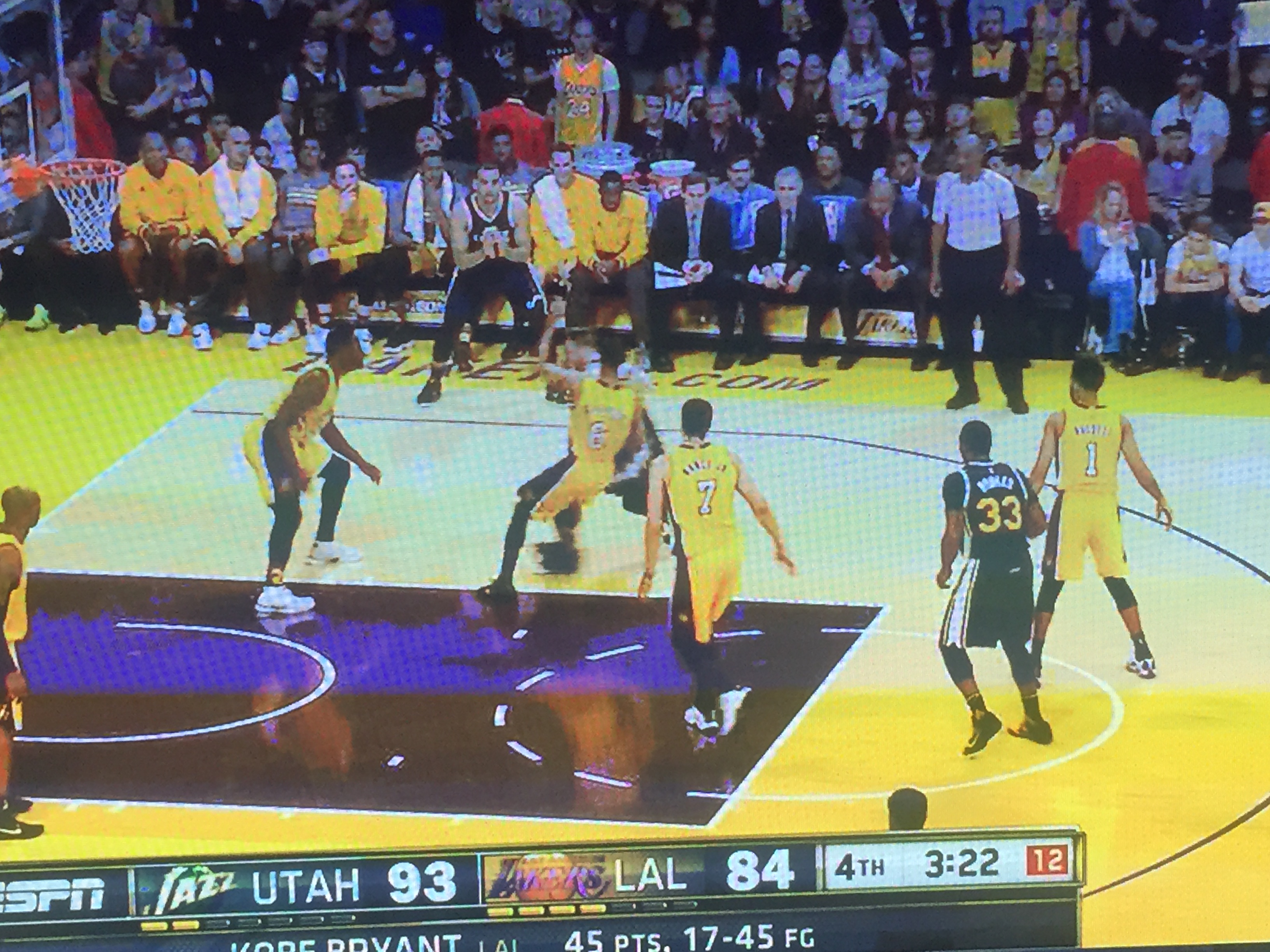
“I Have Front Row Seats to Kobe’s Last Game And…”

Well, I didn’t have seats to Kobe’s last game, in the front row, right next to the Lakers bench. But this woman in the photo below did. What would you do with such a prime location for such a milestone game? I’d probably do one or more of the following:

  • Watch intently
  • Take photos
  • Take video
  • During commercial breaks, post to a social channel or 12.

Now let’s see what this lucky person was doing. By all means, blow up the photo for a better view.

Kobe Bryant Last Game

What could should be doing? What’s your guess?

  • Checking Facebook
  • Calling an Uber so she can get out before the crowd
  • Texting her friends
  • Checking stats

Your thoughts?

Guest Post – The Referee’s Perspective: Sometimes We Know What We Are Doing

Editor’s Note: Garrett Galbreath is a high school basketball official in Washington State and a Board Member for the Snohomish County Basketball Officials. Since I am someone who has ALWAYS treated sports officials with the greatest of respect, and NEVER engaged in any kinds of disagreement with one rearding the idiocy of their calls, laziness on the field, or out and out incompetence, I wanted to get an opinion from his side of the whistle. Why do some parents, coaches, and players insist on arguing with these highly trained and well-meaning people, simply for screwing up a call on the field? This is the 1st post in the series of, “The Referee’s Perspective.”

As high school basketball official, I have heard just about every criticism a coach, player or parent can offer. Sometimes I register the good advice, “Watch the hook on the post!” …and consider it the next time I am in a position to observe post play.

garrettgalbreath_officialBut most of the time, we are bombarded with simple and contradictory instructions for how the game should be officiated. One minute its, “Call the foul!” The next, “Let them play!” What’s an official to do?

The answer is more nuanced than most people think. My general philosophy on officiating is broken into three mandates:
1) Keep the players safe
2) Enforce the rules
3) Consider the game

These (personal) rules are listed in order of importance, but numbers two and three blur a bit in many situations.

Some Examples

Parents Yelling 1Consider a typical 5th grade game. If we were to enforce all the rules in the NFHS rule book, the ball would never cross half-court because we would call travel violations on every possession. Nobody wants to sit through that. Instead, we have to balance where the rules must be enforced and when to let them slide for the sake of the kids trying to learn the game.

As officials, we try to balance the rules vs the game by looking at advantage/dis-advantage. Did a player gain an advantage by violating a rule? No? Maybe it’s best to let it go so the game continues.

Coaches Yelling 2We need to apply the same logic in a high school game. Although our tolerance for violations narrows a bit, we still have to consider the skill level of the players. Our 3A state champion team is probably going to have a different skill level than a rural 2B team with 6 varsity players. We have to figure out how to manage that gap in skill sets every single game.

So to you parents pleading for a foul at one end of the court while imploring that we let them play at the other end… Most of us saw the same thing you saw. By the rule book, you might be correct. We could make you sit through an hour of inbound passes.

Parents Yelling 2But remember, youth and high school sports are for the kids. In addition to being competitive events, they are teaching opportunities and a way for your kids to gain confidence. Our decisions might be different than yours, because we are working hard on blending a need to enforce the rules of the game while considering the quality of the experience.

Please include any questions in the comments below and I’ll be happy to answer them.

One Human, One Block, One Year: An Idea for Solving Homelessness

So file this under pie in the sky, hopeless ideas that have no chance of coming true.

Unless, that is, one person tries to get it going.

NPR published an interesting article the other day about Homelessness in Seattle. One stat stood out: “According to the latest count, in January, more than 3,700 people live on the streets of King County. The number of people sleeping outside shot up by 20 percent in just the past year.”

3,700.

Via NPR

That number sounds enormous when you are thinking about how a government agency could fix the problem. And the government has proven it can’t do it. Here’s another stat from the article, one that should make you pretty mad. “All told, under a 10-year plan put together a decade ago by a public-private partnership called the Committee to End Homelessness, roughly $1 billion has gone to the cause.”

$1 Billion spent in 10 years. 3,700 homeless. At $100 million spent per year, we could just pay every homeless person an annual salary of $27,000 and just close down whatever services are trying to solve the problem.

But 3,700 is also a really small number.

King County has 2.044 Million people. For every 1 homeless person in Seattle, there are 550 non-homeless. This is the math I use to think there’s an opportunity at fixing this problem.

One Human, One Block, One Year
The idea is simple philosophically. Homelessness stops being a macro issue that we need “leaders” and “organizations” to try to solve. Homeless people need to stop being nameless, anonymous shadows that we can easily ignore on the side of the on ramp.

Let’s make homelessness a neighborhood cause. And not just a neighborhood cause, but a block cause.

I’m going to guess that almost every city block contains the following things:
– A house with an unused shed, mother-in-law attachment, garage or other structure that could be fitted with a simple bathroom. (And if not, a group of 20 people who’d split the rent on an apartment for someone.)
– At least one if not more people who hire part-time help.
– Someone who is or knows a psychologist, therapist or life coach.
– A teacher.
– A retired person willing to occasionally give someone a ride.
– Someone who’d spring for a bus pass.
– Neighbors with extra clothing they can give to a specific human.
– People who will donate money to make sure someone they know is well fed.

When you think of the idea that 550 people working together could help a single person get off the street, it seems almost mathematically insane that we have homeless people in the first place.

Now yes, I know that there are gigantic holes in this idea. Addiction, dementia, stubbornness, safety. These are all issues that would have to be dealt with. Then you’d have to get through the government red tape of permits, zoning, etc…

But doesn’t it seem doable? Doesn’t it seem like if everyone who lived on your block assembled for two hours one Sunday afternoon, you could come up with everything you need to get someone a home, a part-time job, a wardrobe, counseling, a bus pass, some education and tutoring, addiction treatment if necessary, and most of all – friends in a neighborhood. Friends who want to see their guest succeed and move on to successfully re-start their own life in 12 months.

That’s my utopian idea. One human, being helped by one block of neighbors, for one year.

Bridging the Social Media Ocean

When I chose to go back to Grad School at the UW  in 2004, I made a conscious decision that after I graduated, I would say “Yes” to every opportunity to learn more that would ever be thrown at me.

In the first few years, saying “Yes” meant speaking at the Undergraduate Marketing Club or Young Entrepreneurs Club, or meeting with VCIC students. That evolved into judging the UW Business Plan Competition, taking on interns for projects and guest lecturing from time to time. Before I knew it, I was teaching  real classes, trying to implement the parts of business school I benefited from the most as a student, while shedding the parts that I saw no value in.

And so here we are today. I just finished up the first part of  the two days I have the privilege to spend working with MBA students visiting the UW from Lucerne University in Switzerland. I wish someone would have asked 4 years ago if I ever thought I’d be teaching students who live 8,000 miles away. I wonder what m response would have been.

My discussions with them today reminded me about something I think proud Seattleites often forget. Namely, there are way more people in the world that don’t share the every aspect of the Northwest’s rain driven, liberal thinking, social media embracing, technology-centric, environmentally-maniacal, privacy shunning state of mind.

For example, other countries haven’t necessarily adopted the idea that every ham sandwich we eat should get its own Instagram photo, or why we would want our boss to know what articles we are reading.  The idea of building personal blogs to gratify our egos and promote our social importance isn’t necessarily a worldwide phenomenon yet.

But what is important is that globally, smart people want to learn more. Whether we are American, Swiss, German, Japanese, Korean, etc… there are people who want to understand how others think. They may not understand why, and they may not want to emulate it, but they want to understand the “how.” And the more people we have around the world who want to learn about how other cultures act, work, play and live, the better chance we have at finding a common ground.

Moral of the story: Always say yes to anything you can learn from.  You’ll never regret it.

Tossing 15 Things a Day

My friend Liz told me that she has a pact with herself. She throws away 15 things a day. It could be 15 pieces of paper, 15 paper clips or 5 shirts and 10 paper towels. It doesn’t matter. 15 things go into the trash (or charity bin).

She said it’s not that hard to do, and less painful than a whole day of spring cleaning.

By the end of the week, she’s tossed 105 things.
By the end of the month, 450.
By the end of the year, 5400.

Maybe I can’t do 15, maybe I can only start with 10. But I am going to start to do that today.

The Power of “Yes”


I could have you click over to Seth Godin’s blog, which I strongly suggest you add to your list of daily reads. (You can even have it delivered via email, it’s that easy…)

But in case you are just browsing through and don’t want to click a link, here’s some wise words for the day.

Seth GodinOn behalf of yes
Yes, it’s okay to ship your work.
Yes, you’re capable of making a difference.
Yes, it’s important.
Yes, you can ignore that critic.
Yes, your bravery is worth it.
Yes, we believe in you.
Yes, you can do even better.
Yes.

Yes is an opportunity and yes is an obligation. The closer we get to people who are confronting the resistance on their way to making a ruckus, the more they let us in, the greater our obligation is to focus on the yes.

There will always be a surplus of people eager to criticize, nitpick or recommend caution. Your job, at least right now, is to reinforce the power of the yes.

Seth, if you want me to pull this down, just say the word. I just felt like sharing it with my own tiny little tribe.

Perfection

20 years from now, anyone who is a Mariners fan will remember how they watched Felix Hernandez dispatch the final 3 Tampa Bay Rays to pitch the 1st perfect game in team history. This video from the Jackson General, the Mariners AA team, is tough to beat.

The Reach of a Tweet

So I work in social media.  I teach some social media.  I play around in some social media channels.  I own a blog with my own name as its url simply so I show up in Google searches.  Through all these years playing around in social media as a profession, I’ve never really made it a huge focus of my personal life.  Maybe I’ll make a connection here or there.  But nothing substantial.

And yet today, a simple tweet seemed to strike a chord with people.

All day long Occupy Seattle mayhem shut down streets downtown.  People couldn’t get home from work.  Rogue anarchists broke windows.  Children couldn’t be picked up from school.  Store clerks feared for their safety.  Middle class parents – and their bosses – had to figure out what was best for their kids, their businesses and their co-workers.

I was unaffected by the chaos despite being right around the corner from it.  I took my wife home from her surgery but thought to myself, “Thank God this mayhem didn’t affect us getting to the hospital, or home from it.” I tried to rid my mind of thoughts of how angry I would be if I was stuck in traffic due to a protest, while my wife sat groggily in pain in the passenger seat of our car.

I scanned the Twitter stream and noticed that people who supported OWS had lost patience with OccupySeattle.  OccupySeattle wasn’t about a revolution anymore.  What started with good intentions but no real purpose, had transformed into an incubator for people with negative intentions and directed purpose. The movement had created a dark side, or at least allowed the dark side to breed.

And so I said:

Dear #OccupySeattle. The 99% has gotten together & decided we need better representation. Thx for the effort.  Good luck w/ future endeavors.”

It was exactly 140 characters.  My point was pretty clear.  Whatever goodwill the original Occupy movement had generated had been pretty much decimated here in Seattle.  The most liberal town in America was saying, “WTF are you guys doing? You are totally destroying this.”

Meanwhile,  my most nagging thought as I hit “Tweet this” was whether I should be using “has” or “have” for the verb.  I was out of characters, so I went with the former. It was a quick line, and after I sent it, I had all but forgotten about it.

A few hours later, it’s become the most retweeted thing I’ve ever sent out. For the first time ever, I started trending in Seattle.  People we retweeting this because they agreed with the sentiment.  And yet two tweets back at me stand out:

To the 1st repsonse I counter, “I agree. To the normal everyday 99%, the rogue hooligans have nothing to do with OWS.  However, Occupy Seattle has little to do with OWS as well.  Somehow OccupySeattle has developed an identity of its own, and not in a good way.”

The 2nd response made me realize I had struck a nerve with some folks.  I run a small business, invest in a startup and teach at a University.  I enjoy creating commerce and inspiring others to do the same.  More commerce means more transactions.  More transactions means more jobs.  More jobs means more wealth for everyone.  But to this person, I was simply “snarky.”  Trying to build small businesses and encouraging entrepreneurship isn’t enough. I’m evil because I don’t want to join or represent a revolution with no goal or purpose.

It will be interesting to see if this tweet fades away into the night as May Day passes.  Maybe more and more people will agree with the sentiment and retweet it.  Or, will we see more of the negative side of #OccupySeattle come out tomorrow.   Either way, it’s a great social media lesson in progress.

« Older posts Newer posts »

© 2026 Andy Boyer

Theme by Anders NorenUp ↑